
For years, the transition to reusable packaging has been framed as a behavioural challenge. Will consumers return packaging? Will they accept reused products? Will convenience win over sustainability?
Evidence from the South Baltic Sea region suggests we may be asking the wrong questions.
The BEPACMAN report shows a consistent and surprising pattern across Germany, Denmark, Poland, and Lithuania: consumer readiness for reuse is higher than businesses assume. The real bottlenecks lie elsewhere — in logistics, standardisation, and system design.
The perception gap that slows down reuse
One of the clearest findings of the study is the mismatch between consumer attitudes and business expectations.
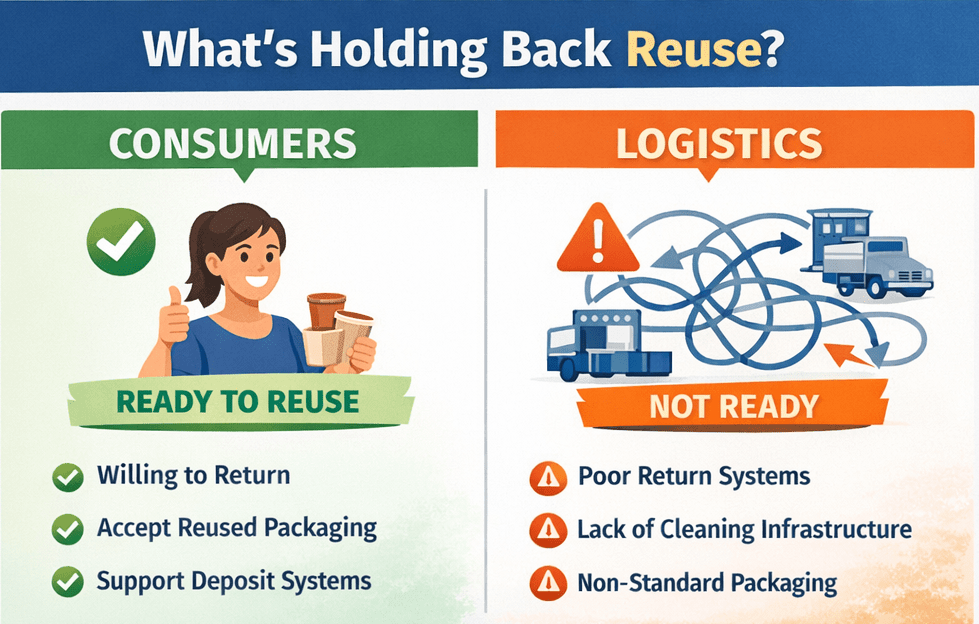
While producers and e-commerce operators frequently cite “low return rates” or “consumer resistance” as key risks, survey data tells a different story. Consumers across the region — particularly in Denmark and Lithuania — express a high willingness to return packaging, accept reused materials, and participate in deposit-based systems.
What holds them back is not motivation, but practical friction:
- unclear return instructions
- lack of nearby return points
- limited storage space at home
- inconsistent systems between brands and countries
In other words, consumers are ready — but only if reuse systems are designed to fit everyday life.
Logistics: the missing backbone of reuse
If consumer behaviour is not the main obstacle, what is?
The answer appears repeatedly throughout the report: logistics infrastructure.
Reusable packaging requires far more than durable design. It depends on:
- efficient return logistics
- cleaning and inspection facilities
- standardised formats that work across supply chains
- cross-border compatibility
Today, these elements are unevenly developed across the South Baltic Sea region. Germany has the most advanced infrastructure, while Denmark leads in experimentation and pilots. Poland and Lithuania show strong industrial potential but lack large-scale systems for return and redistribution.
Without these foundations, reuse remains limited to small pilots — regardless of how willing consumers may be.
Why standardisation matters more than innovation
Another critical barrier identified in the report is the lack of standardisation.
Logistics providers stress that non-standard packaging formats make transport inefficient and costly. Producers, meanwhile, are reluctant to invest in reusable designs without clear, harmonised requirements. For e-commerce companies operating across borders, fragmented national systems add complexity instead of scale.
Standardised reusable formats would allow:
- shared return and cleaning infrastructure
- lower unit costs
- easier consumer participation
- faster cross-border deployment
In this context, standardisation is not a limitation — it is an enabler.
A system challenge, not a mindset problem
The BEPACMAN findings challenge a common narrative: that reuse will only work once consumers change their habits.
In reality, habits follow systems. Deposit return schemes in the region demonstrate this clearly — when systems are simple, familiar, and reliable, participation rates are high.
The shift to reusable paper packaging will depend less on persuasion campaigns and more on system design choices: logistics first, standards early, and infrastructure before scale.
From pilots to systems
The South Baltic Sea region has strong, complementary assets: industrial capacity, regulatory momentum, and consumer openness. What is missing is integration.
Moving from pilots to functioning reuse systems will require coordinated action — across borders, sectors, and value chains. Not because consumers are not ready, but because reuse cannot succeed without the invisible systems that make it easy.