

Reusable paper packaging is no longer an optional sustainability experiment. Across Europe, reuse is becoming a regulatory expectation rather than a voluntary business choice.
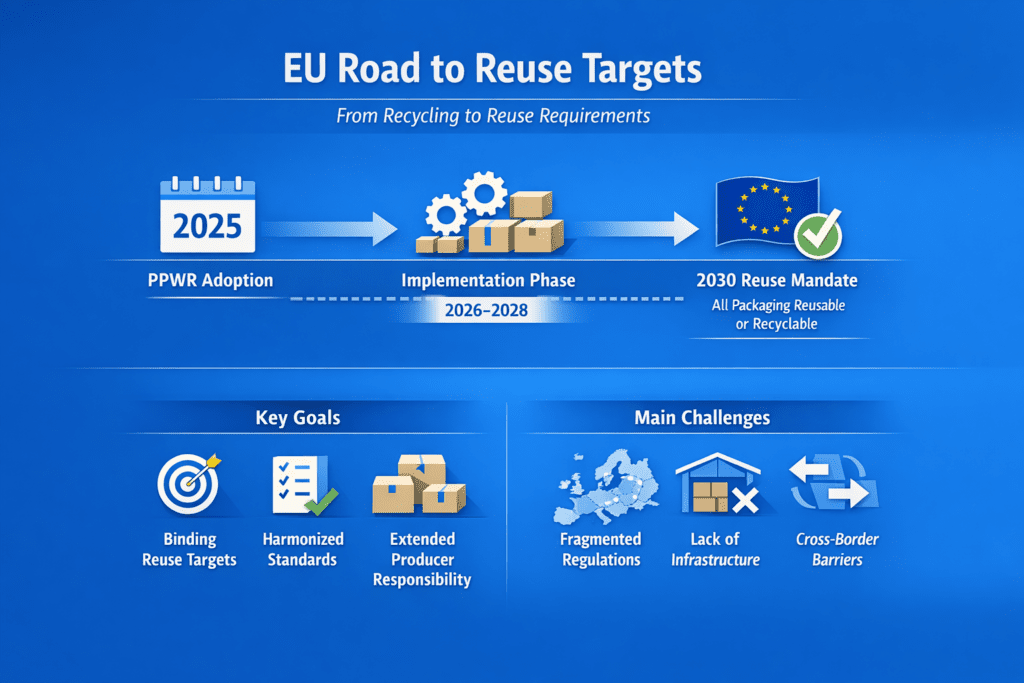
This shift is driven by the European Union’s move away from a recycling-centred model toward a reuse-driven circular economy. The upcoming Packaging and Packaging Waste Regulation (PPWR) is the most significant policy instrument in this transition, introducing binding reuse targets, harmonised design requirements, and stronger Extended Producer Responsibility obligations.
By 2030, all packaging placed on the EU market is expected to be reusable or recyclable.
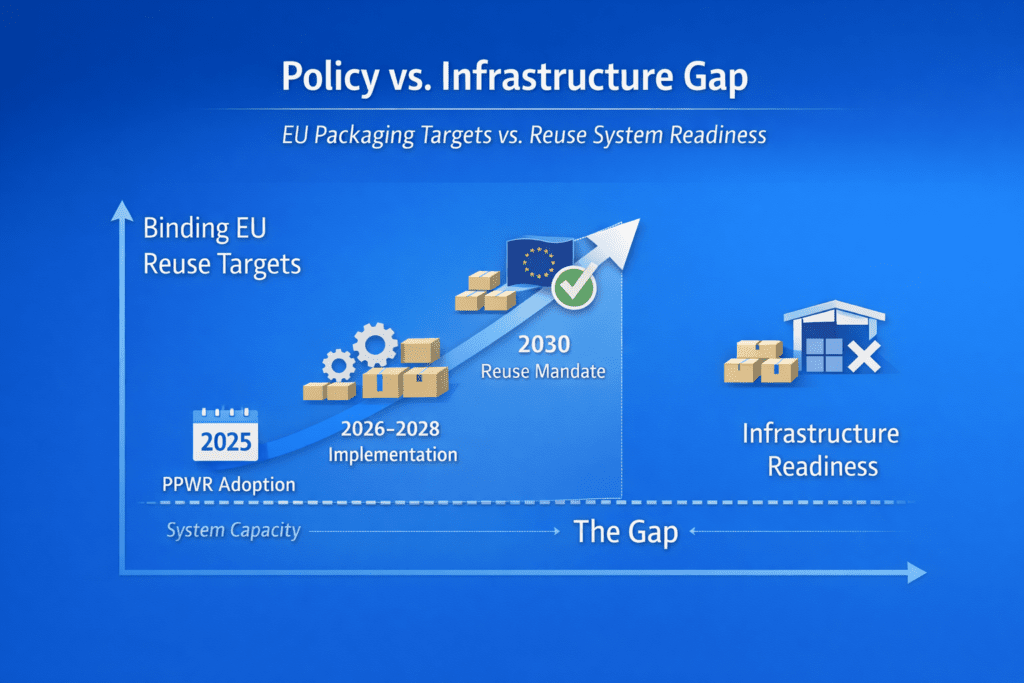
The direction is clear. But the readiness of systems on the ground is not.
From recycling-first to reuse-first policy logic
For decades, European packaging policy focused primarily on recycling targets and waste management efficiency. The underlying assumption was that circularity could be achieved through better end-of-life processing.
The current policy trajectory reflects a different logic.
Reuse is no longer treated as an add-on to recycling, but as a priority pathway in the waste hierarchy. The EU framework increasingly emphasises prevention, reduction, and repeated use over downstream recovery.
The PPWR marks a structural shift: packaging systems are expected to move upstream, redesigning not only materials but entire delivery and return models.
PPWR as the main accelerator
The proposed Packaging and Packaging Waste Regulation is widely seen as the most transformative element of the EU packaging agenda.
Its impact lies in three features:
- Binding reuse targets, moving beyond voluntary commitments
- Harmonised rules across Member States, aimed at reducing fragmentation
- Stronger producer responsibility obligations, linking packaging design to system performance
The regulation effectively makes reuse a compliance issue, not a branding choice.
However, regulation sets direction — it does not automatically create functioning infrastructure.
Regulatory ambition meets system reality
Reusable packaging systems are inherently systemic. Their success depends on more than policy signals or technical feasibility.
They require operational ecosystems:
- return networks
- cleaning and redistribution capacity
- standardised formats
- dense collection infrastructure
- cross-border compatibility
In many parts of Europe, these conditions are still uneven or missing.
The South Baltic Sea region illustrates this clearly. While Germany has the most advanced regulatory environment and stronger enforcement structures, other countries remain at earlier stages of implementation. Denmark shows high consumer engagement and pilot activity, while Poland and Lithuania are still developing reuse infrastructure despite strong industrial potential.
This creates a landscape where policy expectations are rising faster than practical readiness.
Fragmentation as a structural barrier
One of the central challenges is regulatory and infrastructural fragmentation between Member States.
Reusable packaging loops do not stop at national borders. Logistics networks, e-commerce flows, and supply chains are increasingly regional.
Yet reuse systems remain constrained by:
- inconsistent national implementation
- varying infrastructure density
- different enforcement levels
- lack of shared standards
Without harmonisation not only in regulation but in operational design, cross-border reuse models struggle to scale.
Fragmentation risks turning reuse into a patchwork of pilots rather than a unified market transition.
When infrastructure lags behind targets
The risk is not that reuse targets are unrealistic.
The risk is that they become symbolic if the supporting systems are not built fast enough.
If packaging is legally required to be reusable, but return points are scarce, cleaning hubs absent, and formats non-standardised, compliance becomes a formal label rather than a functional loop.
In that scenario, policy creates pressure — but not performance.
The decisive question is no longer whether reuse is mandated.
It is whether infrastructure can catch up with regulation before targets turn into unmet obligations.
The gap will determine the outcome
Europe’s policy direction is now firmly aligned with reuse. The regulatory momentum is accelerating, and the PPWR is setting a clear framework for the next decade.
But reusable packaging cannot be legislated into existence.
It must be operationalised through:
- investment in return and cleaning systems
- standardisation across markets
- cross-border coordination
- realistic implementation pathways
The transition to reuse will be decided not by ambition alone, but by the speed at which infrastructure and systems can match the regulatory timeline.
The gap between policy and practice is now the critical battleground.