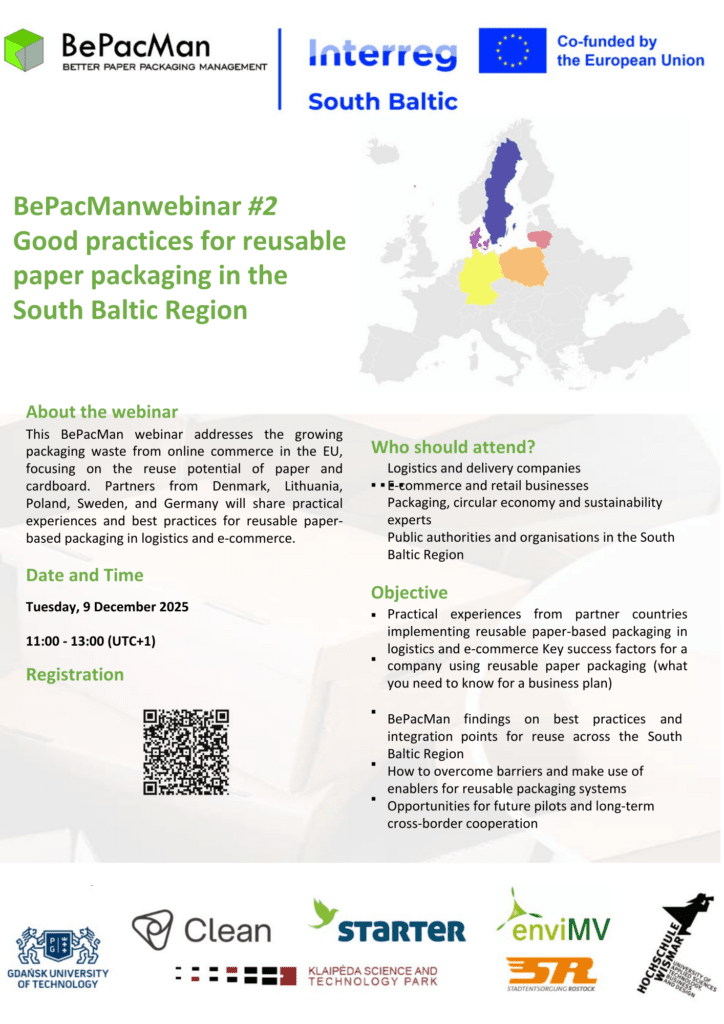
On 9 December 2025, the BePacMan project organised an international webinar dedicated to good practices for reusable paper packaging systems in the South Baltic region. The online event was hosted by enviMV and brought together project partners and stakeholders interested in circular packaging solutions.
The webinar focused on real-world case studies demonstrating how reusable packaging systems can be implemented in logistics and e-commerce.
Case studies from across the region
Participants learned about several practical models of reusable packaging systems implemented in different countries.
One example was the German startup Hey Circle, which provides reusable shipping boxes for e-commerce businesses. Their packaging can be reused up to 50–60 times and offers significant cost savings across the packaging lifecycle.
Another example was the LP Express reusable packaging system in Lithuania, which integrates reusable packaging into an existing postal and parcel locker network. This model demonstrates how existing logistics infrastructure can support large-scale reuse systems.
The webinar also discussed the role of regulatory frameworks, such as extended producer responsibility systems, in creating financial incentives for companies to adopt reusable packaging solutions.
Key insights
The discussions highlighted several key factors necessary for scaling reusable packaging systems.
Convenience for users was identified as the most important factor influencing return rates. Participants emphasised that reuse systems must be easy and accessible for consumers in order to achieve high participation rates.
The importance of logistics infrastructure was also highlighted, particularly the role of parcel lockers and postal networks in enabling efficient return flows.
Reusable packaging systems can significantly reduce environmental impact once a sufficient number of reuse cycles is achieved, offering lower CO₂ emissions and reduced resource consumption compared to single-use packaging. Summary for webinar 09.12.2025
The webinar demonstrated that reusable packaging systems are already technically feasible and that further collaboration between businesses, policymakers and researchers will be essential for scaling these solutions across the South Baltic region.